The Elpis Collection
Stories that shape us. Not as history. As inheritance. Because art is the highest form of hope.
Kathrine Switzer
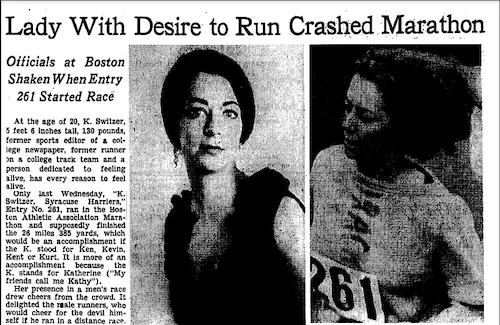
Boston, 1967.
The rules were clear: women were not allowed to run the Boston Marathon.
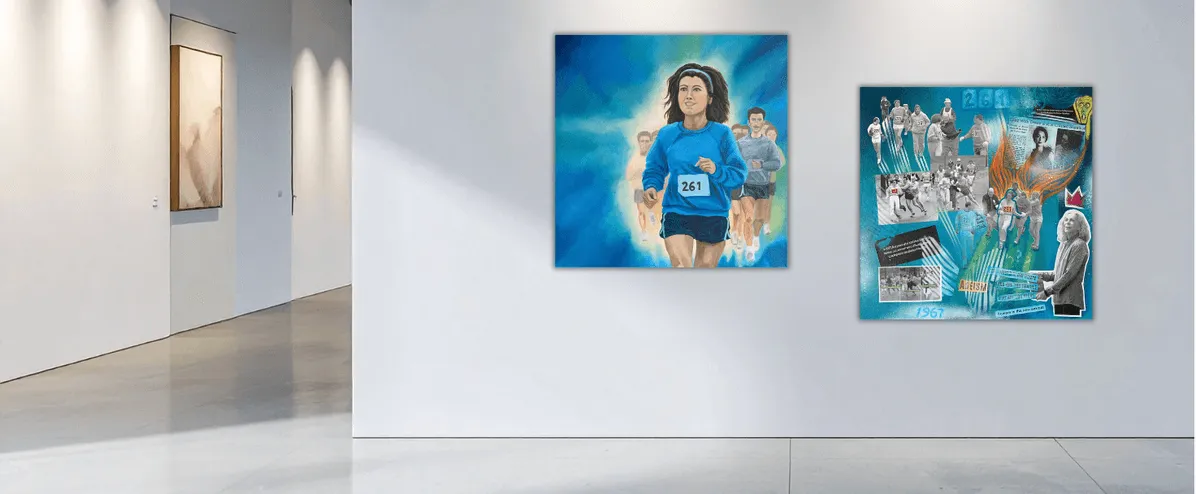
In The Elpis Collection
Gosia Margie Witko
Size: 40x40
Medium: acrylic on canvas
Availability: Not Available
Front of the painting:
She is in motion. Abstract, defiant, alive.
Back of the painting:
The struggle is revealed.
A contemporary collage of headlines and resistance. The moment she was nearly erased.
Two sides of one truth: movement and obstruction, presence and resistance.
Origin Story
K. V. Switzer
Kathrine Switzer was born in 1947 in Amberg, Germany, and raised in the United States.
By the mid-1960s, she was a journalism student at Syracuse University and had begun training seriously as a distance runner under coach Arnie Briggs, who had run the Boston Marathon multiple times.
At that time, long-distance running was considered medically inappropriate for women. Popular myths claimed women’s bodies were too fragile, that endurance running would harm reproductive health, that it was unfeminine.
The Boston Marathon, organized by the Boston Athletic Association, did not explicitly list “men only” in its rulebook in 1967.
But women were not permitted to register.
Switzer trained through winter conditions in New York.
She met qualifying standards.
She completed the required long runs.
When she filled out her entry form for the 1967 Boston Marathon, she signed it as she always had:
K. V. Switzer
Her application was accepted.
On April 19, 1967, she stood at the starting line wearing bib number 261.
Resistance
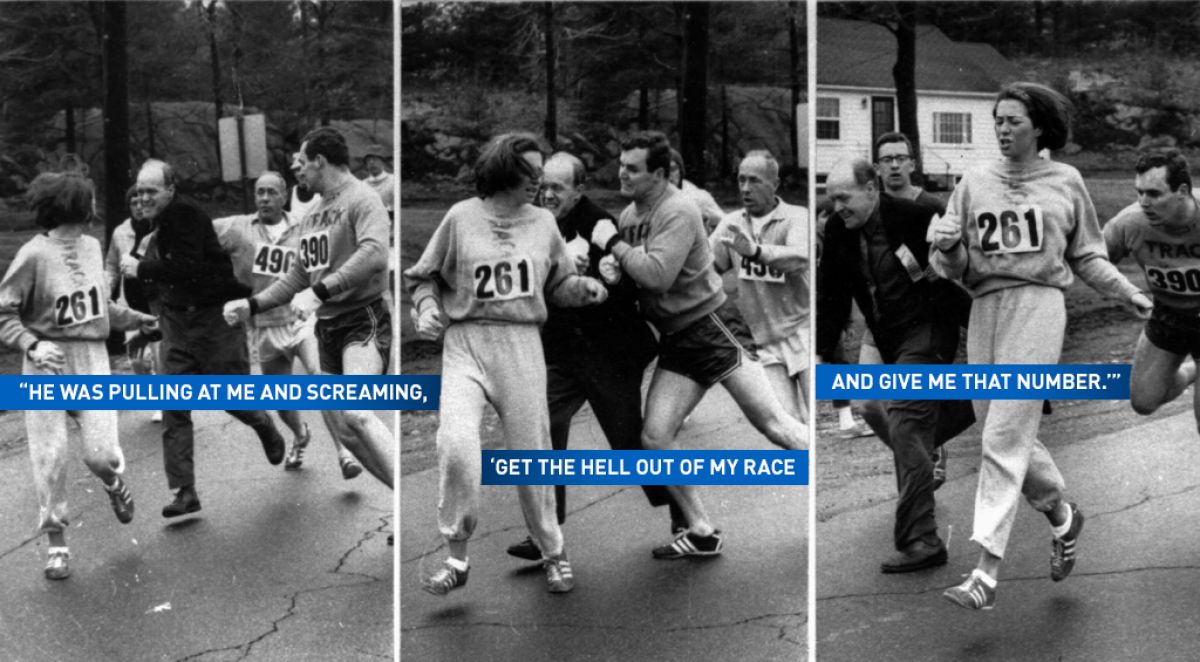
Mile Four
Approximately four miles into the race, race co-director Jock Semple noticed her running.
He ran toward her in anger, attempting to physically remove her from the race and tear off her bib number.
The moment was photographed.
Those images circulated internationally, becoming some of the most recognizable sports photographs of the twentieth century.
Her teammate and fellow runner Tom Miller intervened, pushing Semple away.
Other runners shielded her.
Switzer continued running.
She completed the race in approximately 4 hours and 20 minutes.
Afterward, the Amateur Athletic Union (AAU) moved to formally ban women from competing in races against men, tightening restrictions rather than loosening them.
The resistance did not end at mile four.
It shifted into policy.
Becoming
What She Exposed
Change did not happen immediately.
In 1972, five years later, the Boston Marathon officially opened registration to women.
Switzer had not stopped in the meantime.
She became a vocal advocate for women’s distance running, helping to organize women’s races and campaigning for broader inclusion.
In 1974, she won the New York City Marathon.
In 1975, she finished second in the Boston Marathon.
Through the 1970s and 1980s, she worked with sponsors and organizers to expand women’s marathon participation globally.
In 1984, the women’s marathon was included in the Olympic Games for the first time at the Los Angeles Olympics.
What began as a contested presence became institutional recognition.
In 2017, fifty years after her first Boston Marathon, Switzer ran the race again at age 70, wearing bib number 261.
The number had transformed from an attempted erasure into a symbol of endurance.
You Are The Future Ancestors

What will you carry forward?
When Kathrine Switzer began running marathons, there were virtually no official opportunities for women in long-distance road racing.
In 1967, specialized running shoes for women were largely unavailable, forcing female runners to use men's, children's, or non-athletic footwear like nurses shoes.
Today, women constitute a significant percentage of marathon participants globally.
That shift did not begin with policy. It began with presence. With someone entering the course before permission existed.
This is not only a story about sport.
It is a story about who is allowed to occupy public space.
It is a story about how systems reveal themselves when challenged.
It is a story about the quiet difference between waiting and entering.
You are the future ancestor.
The structures around you were shaped by people who refused to disappear.
What is normal in your world that once required someone to endure resistance?
What system feels immovable — until someone moves through it?
What will you carry forward?
New Challenges

Ageism
She kept going long after 1967.
She became a global advocate for women in sport.
She helped expand opportunity for women runners worldwide.
She carried the story forward, not as a single moment, but as a continuous path.
Decades later, she still runs.
Now, she faces a different barrier: ageism.
Once again told she is too weak, too frail, past her time.
Once again asked to step aside.
And still, she runs.
Further Exploring

When Kathrine Switzer became the first woman to officially run the Boston Marathon in 1967, it sparked a lifelong quest to promote women’s running, which culminated in her securing a spot for the women’s marathon in the 1984 Olympics. Now 79, Kathrine has started a global non-profit to empower women through running in countries where women’s rights are woefully denied.
Kathrine Switzer is one of running’s most iconic figures. She’s known not just for breaking barriers, as the first woman to officially run the Boston Marathon in 1967, but for her continued work promoting women’s running.
She was responsible for getting women’s marathon running accepted into the Olympics in 1984 and continues to empower women through running with her not-for-profit, 261 FEARLESS, which currently has running clubs in 14 countries.
Kathrine Switzer Official Website
https://kathrineswitzer.com
261 Fearless (women’s running community founded by Switzer)
https://261fearless.org
Boston Athletic Association: Boston Marathon history (women’s inclusion timeline)
https://www.baa.org
Marathon Woman (book) by Kathrine Switzer
https://kathrineswitzer.com/shop/
Tough Old Broads Film (February 10, 2026)

©Gosia Margie Witko | Privacy Policy